At some point, every Sheffield homeowner faces the same uncomfortable question: Do I fix this boiler again, or is it finally time to replace it?
This isn’t something most people decide on quickly. Spending £2,500 on a new boiler feels significant. However, so does paying for a repair on a unit that breaks down again three months later, putting you back at square one. There’s no single rule that fits every situation, but a clear set of indicators, based on boiler age, fault type, repair cost, and running efficiency, takes most of the guesswork out of it. This guide covers all of it, including real 2026 cost figures and a few things heating companies don’t always mention but really should.
Why the Decision Is More Complicated in 2026
A decade ago, repair vs replacement came down to a fairly simple calculation. In 2026, the picture has shifted. Energy efficiency now has a direct, measurable impact on annual bills, and the gap between an ageing boiler and a modern condensing unit has widened enough to matter. Parts availability for legacy models is also a growing concern, with some manufacturers phasing out support for older systems. Homeowners who look at the full picture, not just the immediate repair quote, consistently make better decisions.
The 50% Rule: A Starting Point, Not the Whole Story
The most commonly cited benchmark is the 50% rule: if a repair costs more than 50% of a replacement, replacement is generally the wiser choice. It’s reasonable, but it has limits.
If you have a nine-year-old boiler and the repair is £400 against a £2,500 replacement, the maths says repair. But if that same boiler has been fixed twice in the last two years, the conversation changes entirely. Repair history matters just as much as the individual quote. The rule also says nothing about running efficiency; an older boiler at 78% versus a modern unit at 93% means losing real money every month. Use it as a starting point, then apply everything else in this guide before deciding.
Boiler Repair Cost Sheffield 2026: Realistic Figures
Repair costs in Sheffield vary depending on the fault, the boiler’s age, and parts availability. Here’s an honest breakdown.
Minor repairs: £80 to £250. Straightforward faults a Gas Safe engineer can diagnose and fix in a single visit: faulty thermocouples, pressure relief valve replacements, pilot light issues, and minor PCB faults where the board can be reconfigured rather than replaced.
Mid-range repairs: £250 to £600. Component replacements that take longer or require more expensive parts include pump replacements, expansion vessel work, motorised valve faults, and diaphragm replacements. For a boiler under eight years old, this is usually worth doing without much hesitation.
Major repairs: £600 to £1,200 and above. Full heat exchanger replacement on a larger boiler, significant PCB failure, or major internal work. At this cost level, boiler age and condition need careful thought before committing.
One Sheffield-specific point worth noting: older properties in areas like Crookes, Nether Edge, and Walkley often have boilers tucked in awkward spots under stairs, in narrow utility rooms, or in loft spaces, which adds time and labour cost to any job. Always get the diagnosis and a written quote before assuming a fault is straightforward.
New Boiler Cost Sheffield 2026: What You’ll Actually Pay
There’s a tendency in the industry to quote headline prices that don’t reflect what most homeowners end up paying once installation is factored in.
Combi boiler supply and installation: £1,800 to £3,200. The most common installation type across Sheffield. The range reflects the difference between a straightforward like-for-like swap and a more complex job where the boiler is repositioned, pipework needs updating, or a system flush and magnetic filter are properly included.
System boiler supply and installation: £2,000 to £3,500. Found in larger Sheffield homes where a combi can’t meet hot water demand across multiple bathrooms. Generally, a more involved installation.
Heat-only (conventional) boiler supply and installation: £1,900 to £3,200. Still common in older Sheffield properties, particularly Victorian terraces. If the property already has a cylinder and feed tank in reasonable condition, this can be a cost-effective replacement route.
Labour rates in South Yorkshire are generally lower than in London and the South East, which helps. However, Sheffield’s older housing stock means pipework condition, flue positioning, and access issues add cost more often than they would in newer developments. A 1930s semi in Hillsborough is more likely to need additional work during a boiler swap than a 1990s new build in Mosborough. Get at least three quotes and make sure you’re comparing the same scope across all of them.
Age: The Most Reliable Indicator
Boiler age is the single most consistent factor in this decision.
When the boiler is still under five years old, repairing it is often the better option. Parts are available, efficiency is competitive, and replacement cannot be justified for most faults. If it’s still within warranty, it may be covered entirely.
5 to 8 years old: Repair is still generally the right call for minor to mid-range faults. For major repairs, particularly heat exchanger failure, getting a replacement quote alongside the repair quote is sensible before deciding.
8 to 12 years old: the grey zone. A reliable boiler with a straightforward fault is still worth repairing. A boiler with a pattern of repeated faults in this age range is pushing toward replacement.
Over 12 years old: replacement becomes the increasingly likely recommendation for anything beyond a minor repair. Parts for older models are harder to source, lead times are longer, and the efficiency gap between an ageing boiler and a new one is at its widest.
Over 15 years old: a major repair is rarely advisable. Even a mid-range repair on a fifteen-year-old boiler is difficult to justify when you consider the likelihood of further faults and the efficiency savings a modern replacement would deliver.
The Running Efficiency Cost Most People Overlook
This is the gap in most repair vs replacement conversations, and it deserves more attention.
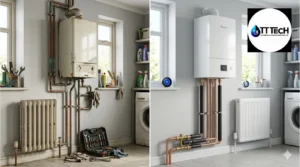
The difference between an older G-rated boiler and a modern A-rated condensing unit is roughly 20 to 25% in fuel efficiency. A household spending £1,400 a year on gas might spend closer to £1,050 to £1,120 with a modern replacement, a saving of £280 to £350 annually. Over five years, that’s £1,400 to £1,750, which, combined with fewer repairs, starts to approach the cost of the replacement itself.
This matters most for Sheffield homeowners still running pre-2005 non-condensing boilers. The repair cost looks modest. But running an inefficient boiler is its own ongoing expense; it just doesn’t arrive as a single bill, which makes it easier to ignore.
Repair History Changes the Calculation
A single repair on a reliable boiler is very different from a third repair in eighteen months. If your boiler has needed repeated attention, that pattern is worth taking seriously before authorising another fix.
Ask yourself: how much have you spent on this boiler in repairs over the last three years? If the cumulative total is approaching £800 to £1,000 and the boiler is over eight years old, you’re likely in diminishing returns territory. The money already spent doesn’t come back, but what you’d spend on the next repair could go toward a replacement that runs reliably for another fifteen years and doesn’t leave you facing an emergency call-out charge in the middle of January.
When to Repair and When to Replace
Repair is the right call when the boiler is under ten years old and has been reliable, the repair is under £400 for a single identifiable fault, it’s the first repair in several years, parts are readily available, and the work can be completed in one visit.
Replacement makes more sense when the boiler is over twelve years old with a major fault, the repair cost exceeds 50% of replacement, there have been two or more repairs in the last two years, parts are hard to source or on long lead times, efficiency is noticeably poor, or the fault is a cracked heat exchanger which is rarely worth repairing on anything but a fairly new unit.
If you’re selling the property in the near term, a repair that makes the boiler functional is often more practical than a full replacement. Though in the right market, a new boiler can be a genuine selling point worth factoring in.
Should You Be Considering a Heat Pump?
This question comes up more in 2026 than it did two or three years ago, and it deserves a straight answer. Air source heat pumps work best in well-insulated properties. If your Sheffield home has solid wall insulation, double glazing, and a strong EPC rating, a heat pump is worth exploring, particularly with the government’s Boiler Upgrade Scheme currently offering £7,500 toward installation.
That said, a heat pump is not a like-for-like swap. Installation costs are significantly higher, existing radiators may need upgrading, and the system operates differently. For most older Sheffield terraces without meaningful insulation improvements, a high-efficiency gas boiler remains the more practical solution in 2026. If you’re in a well-insulated property and thinking long-term, get a heat pump survey alongside your boiler quotes. If you need heating sorted this winter in a standard older property, a modern gas boiler is still the right answer for most households.
Choosing the Right Engineer in Sheffield
The quality of the engineer matters as much as the decision itself. Always check that any engineer is on the Gas Safe Register verify at gassaferegister.co.uk using their licence number.
For replacements, look for engineers who include a full system flush as part of the job rather than an optional extra, fit a magnetic filter as standard, provide a written guarantee on parts and labour, and can explain clearly why they’re recommending a particular model. Local Sheffield engineers familiar with the city’s housing stock often have a practical advantage when older properties are involved.
A Quick Decision Framework
If you’re sitting with a fault right now and need to make a call, work through these in order:
- How old is the boiler? Under 8 years lean toward repair. Over 12 years lean toward replacement for major faults.
- What is the repair cost? Under £300 for a boiler under 10 years old repair is almost always right. Over £600 on a boiler over 10 years old, get a replacement quote first.
- How many repairs in the last two years? More than one weight this heavily.
- What is the efficiency rating? Pre-2005 non-condensing boilers carry a meaningful ongoing cost worth calculating.
- How long are you staying? Under two years of repair. Five or more replacements may well pay for themselves.
Frequently Asked Questions
What is the average boiler repair cost in Sheffield in 2026?
Most faults come in at £150 to £500 for a single-visit diagnosis and repair. Major component replacements can reach £600 to £1,000. Always get a written quote before authorising work.
How long should a boiler last?
A well-maintained combi boiler should last 12 to 15 years. Annual servicing is the biggest factor in extending the life of boilers; without regular service history tends to fail earlier and more expensively.
Is it worth repairing a 10-year-old boiler?
A single straightforward repair on a well-maintained ten-year-old boiler is usually still worth doing. Repeated repairs or a major fault at that age shifts the case toward replacement.
Which boiler brands are most reliable in 2026?
Worcester Bosch, Viessmann, and Vaillant consistently perform well in reliability surveys with strong UK parts availability. Baxi and Ideal are also widely fitted and well supported locally. Correct sizing and a quality installation matter more than brand name.
Does a new boiler reduce energy bills?
Yes, meaningfully so when replacing an older, inefficient unit. Moving from a G or E-rated boiler to a modern A-rated condensing model can cut gas consumption by 20 to 25%, which shows up as a real reduction in annual bills.