If you have been thinking about underfloor heating for your Sheffield home, you are probably tired of wading through generic guides that tell you costs for London and Bristol but say nothing useful about what you will actually pay in South Yorkshire. This guide covers everything you need to know, including how much wet and electric systems cost in 2026, how long installation takes, what type of home suits which system, and whether the whole thing is actually worth it.
Sheffield is a city of contrasts when it comes to housing. You have Victorian terrace rows in Sharrow and Walkley, 1930s semis in Crosspool and Dore, modern new builds out near Waverley and Mosborough, and everything in between. The type of property you own has a direct impact on which underfloor heating system makes sense and how much it will cost.
What Is Underfloor Heating and Why Are Sheffield Homeowners Interested in It?
Underfloor heating (UFH) warms a room from the floor up rather than pushing hot air from wall-mounted radiators. Heat rises slowly and evenly across the entire floor surface, meaning your feet are warm, the room feels comfortable at a lower thermostat setting, and you avoid the cold spots and draughts that radiators create.
Rising UK energy bills have pushed homeowners toward more efficient heating. Wet underfloor heating runs at a much lower flow temperature than a traditional radiator system, pairing well with modern heat pumps and condensing boilers. When your system operates at 35 to 45 degrees Celsius rather than 70 to 80 degrees, your boiler runs more efficiently, and your energy bills come down. There is also the practical benefit of freeing up wall space, which matters in Sheffield terraces and semis where wall space is genuinely limited.
Wet vs Electric Underfloor Heating: What Is the Difference?
Wet (Hydronic) Underfloor Heating
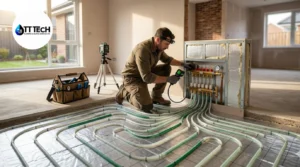
Wet underfloor heating circulates warm water through underfloor heating pipes laid beneath the floor, connected to a UFH manifold that regulates water flow to different zones. The manifold is fed by your boiler or heat pump. Pipes are embedded in floor screed or clipped into insulation boards. Installation is more involved and costly upfront, but running costs are considerably lower, particularly in a well-insulated home with a modern boiler. For Sheffield homes doing a new build, large extension, or full ground-floor renovation, wet systems are almost always the better long-term choice.
Electric Underfloor Heating
Electric systems use heating mats or thin wire cables laid beneath tiles, LVT, or engineered wood, connected directly to your electrical supply with no pipes or manifold. They are quicker to install, less disruptive, and far cheaper upfront, making them ideal for single rooms, bathrooms, and kitchen refits. The downside is running costs. Electricity costs more per unit than gas, so electric UFH works best as a supplementary comfort system rather than a whole-house solution.
Feature | Wet UFH | Electric UFH Installation cost | £120 to £185 per m² | £50 to £85 per m² Running costs | Lower (especially with heat pump) | Higher (electricity rates) Best for | Whole house, new builds, extensions | Single rooms, bathrooms, retrofits Heat-up time | 30 to 60 mins | 15 to 30 mins Disruption | High | Low to moderate Lifespan | Up to 50 years | 25 to 30 years
UFH Installation Cost in Sheffield: What to Expect in 2026
Sheffield sits in a mid-range position compared to the rest of England. Labour rates for heating engineers in Sheffield typically run 10 to 15 per cent below the national average, which makes a meaningful difference on larger jobs.
For a bathroom of around 5 to 7 square metres, electric UFH costs between £400 and £700 all in. A kitchen of 12 to 15 square metres runs from £700 to £1,200. Materials sit at roughly £50 to £80 per m², with labour adding £20 to £35 per m² in Sheffield.
Wet systems cost more. For a ground floor of around 60 square metres in a Sheffield semi-detached, budget between £5,500 and £8,000 including underfloor heating pipes, insulation boards, underfloor insulation, floor screed, UFH manifold, and installation. New build underfloor heating is considerably cheaper at £40 to £70 per m² because floors are open during construction.
Scenario | Estimated Cost (Sheffield, 2026) Bathroom electric UFH (6m²) | £400 to £700 Kitchen electric UFH (14m²) | £700 to £1,200 Single room wet UFH (20m²) | £1,800 to £3,200 Ground floor wet UFH (60m²) | £5,500 to £8,000 New build whole-house wet UFH | £40 to £70 per m² Retrofit wet UFH (existing home) | £120 to £185 per m²
Always get at least three quotes from Sheffield-based installers. Costs vary based on floor type, subfloor condition, and whether any remedial work to your boiler or electrical supply is needed first.
How Long Does Installation Take?
A single bathroom with electric heating mats is typically a one-day job. For a larger open-plan room, allow two to three days, including preparation, wiring, and testing.
Wet systems take considerably longer. A ground floor of 50 to 60 square metres typically takes four to seven working days for an experienced team. The critical point many homeowners overlook is screed curing time. Once wet UFH pipes are embedded in screed, standard sand and cement screed takes four to six weeks to cure before floor coverings can go down. Liquid anhydrite screed, which is often preferred with UFH for its superior thermal contact with the pipes, still needs two to four weeks. Plan for a total project timeline of six to ten weeks from start to finished floor.
Underfloor Heating vs Radiators in Sheffield Homes
Upfront Cost
Radiators win on upfront cost. A standard radiator system in a Sheffield three-bedroom semi costs £2,500 to £4,500 to install, compared to £6,000 to £9,000 for wet UFH in the same property.
Running Costs
Wet UFH wins on running costs. Because it operates at lower water temperatures, your boiler runs in condensing mode more consistently, extracting more heat per unit of gas. Over the system’s lifetime, this offsets the higher installation cost. Electric UFH and electric radiators have broadly similar running costs, so for Sheffield homes without gas, the choice between them comes down more to comfort and aesthetics.
Comfort
UFH provides even, consistent warmth without hot and cold zones. Many homeowners run their thermostat one to two degrees lower after switching to UFH and still feel just as warm. Radiators heat rooms faster, which matters if you want a room to be warm in ten minutes. UFH needs more lead time, which is why smart thermostats and good programming matter more with UFH.
Suitability for Sheffield’s Older Housing Stock
Victorian terraces and Edwardian semis across Sheffield were built with solid or suspended timber floors and solid external walls that are harder to insulate. Underfloor insulation is essential for UFH to work efficiently. Without it, heat disappears downward into the subfloor rather than rising into the room. In a poorly insulated Sheffield home, wet UFH can become expensive to run. Before committing, get a heat loss calculation done to confirm UFH can deliver the required output within the floor temperature limits safe for your floor covering.
Retrofit Underfloor Heating in Sheffield
Solid Concrete Floors
Solid concrete ground floors are good candidates for wet UFH retrofits. Pipes are laid on underfloor insulation boards and embedded in a new screed layer. The main challenge is floor height. You may be raising your floor level by 70 to 100mm, which requires adjustments to door frames, skirting, and any fitted kitchen units. This needs early planning.
Suspended Timber Floors
Pipes are routed between floor joists and attached to heat spreader plates that distribute warmth upward through the floorboards. This avoids raising floor height but requires adequate access under the floor via the floor itself or a crawl space. Insulation between and below the joists is critical, as significant heat is lost downward.
Overlay Systems
Where raising floor height is not possible, and joist access is not available, low-profile overlay systems use thin insulation boards with pre-routed pipe channels, adding only 15 to 20mm of height. They offer slightly lower heat output than full screed installations but are a practical solution for many Sheffield properties where a full retrofit is not feasible.
Floor Coverings and UFH
Porcelain and ceramic tiles are ideal, conducting and retaining heat effectively. LVT is also excellent and widely used in Sheffield kitchens and bathrooms. Engineered wood works if it is UFH-compatible and the temperature is managed correctly. Solid wood can be used, but requires careful control to prevent movement or cracking. The maximum safe floor surface temperature for most wood floors is 27 degrees Celsius. Thick carpets with a tog rating above 1.5 should be avoided as they insulate the floor covering so effectively that heat cannot enter the room efficiently.
UFH Running Costs and Energy Bills
For a wet UFH system covering 60m² in a reasonably well-insulated Sheffield semi connected to a modern condensing boiler, most homeowners replacing an older radiator system report broadly similar or slightly lower total bills, as the boiler’s improved efficiency offsets the cost. For electric UFH in a 6m² bathroom running two hours daily, running costs come to around £30 to £50 per year at current rates.
The biggest efficiency driver is thermostat strategy. UFH works best when left at a consistent low temperature rather than switched on and off. A setback approach, where temperature dips slightly overnight but never drops to zero, is more efficient than treating it like a radiator system and is better for the system’s long-term health.
Choosing a UFH Installer in Sheffield
For wet UFH, look for a heating engineer with specific UFH experience who can demonstrate previous installations and show you their manifold work. A properly balanced system ensures even heat distribution across all zones. For electric UFH, the work must be done or signed off by a qualified electrician registered with NICEIC or NAPIT. This is a warranty requirement and matters when you come to sell your Sheffield home. Always get three quotes and ask exactly what each one includes: floor preparation, screed, thermostats, and commissioning should all be accounted for.
Is Underfloor Heating Worth It in Sheffield in 2026?
For new builds, extensions, and full ground-floor renovations, wet UFH is almost always the right long-term choice. The higher upfront cost is offset by lower running costs, increased comfort, and genuine appeal to buyers in Sheffield’s competitive housing market.
For bathroom and kitchen refits, electric UFH is absolutely worth it. The cost is modest, installation is quick, and warm tiles on a cold Sheffield morning are a genuine daily benefit.
For older Sheffield terraces with poor insulation where a full renovation is not planned, improving insulation first and revisiting UFH as part of a future project is the wiser approach. UFH works best in well-insulated homes with appropriate floor coverings and a properly commissioned system. Get those things right, and it will perform well for decades.
Conclusion
Underfloor heating in Sheffield suits a wide range of homes, from Hillsborough to Dore and Crookes to Beighton. Wet systems deliver long-term efficiency and comfort for whole-floor applications. Electric systems offer an affordable, low-disruption route to warm floors in individual rooms. In 2026, with energy bills still a concern and heat pump adoption growing, the case for UFH as part of a Sheffield home’s heating strategy is stronger than ever. Get three quotes, sort your insulation, choose the right floor covering, and you will be well placed to enjoy the benefits for years to come.
Frequently Asked Questions
1. How much does underfloor heating cost to install in Sheffield?
Electric UFH typically costs £400 to £1,200 for a single room. Wet hydronic systems for a 60m² ground floor usually run £5,500 to £8,000 including labour and materials. New build installations come in at £40 to £70 per m² because floors are open during construction.
2. Can I fit underfloor heating in my older Sheffield terrace?
Yes, but it requires planning. Solid concrete and suspended timber floors can both accommodate UFH retrofits using different approaches. Floor height gain is a common challenge, and underfloor insulation is non-negotiable. A heat loss assessment is recommended for any pre-1920s Sheffield property before committing.
3. How long does it take to install wet underfloor heating?
Physical installation takes four to seven working days for a full ground floor. Add four to eight weeks for the screed to cure before floor coverings can go down. The total project timeline is typically six to ten weeks.
4. Is underfloor heating cheaper to run than radiators in Sheffield?
Wet UFH generally costs less to run than a conventional radiator system when connected to a modern condensing boiler or heat pump, as lower flow temperatures mean the boiler runs more efficiently. Electric UFH costs more per unit to run and is better suited as a comfort supplement than a primary heat source.
5. What floor coverings work best with underfloor heating in Sheffield homes?
Porcelain and ceramic tiles are the best performers. LVT is excellent and widely used in Sheffield renovations. Engineered wood works with careful temperature management. Avoid thick carpets with tog values above 1.5 as they significantly reduce heat transfer into the room.